


There are two dominant stories about artificial intelligence right now:
The Abundance Theory: We are approaching machine abundance. Models will become more capable, cheaper, and increasingly autonomous. They will transform knowledge work, science, education, and medicine. The transition will be profoundly disruptive and institutions that move slowly will be left behind in the short term. Eventually, there will be peace and abundance.
The Bubble Theory: the entire generative-AI economy is being held up by subsidies, opaque accounting, forced adoption, and promises that the technology cannot fulfill. The capital spending is too large, the revenue is too small, and the useful product underneath the marketing is far more ordinary than its owners admit.
Bill Gates has recently made the strongest mainstream version of the first argument, although with much less optimism about the transition than he expressed several years ago: https://www.gatesnotes.com/home/home-page-topic/reader/a-turbulent-ai-era-and-critical-choices-to-make
We need to notice what both stories imply for us: it is strategically reckless to let a small number of cloud vendors become the only place where our AI capability, workflows, institutional memory, and professional leverage live.
That does not mean abandoning frontier models… It means building enough physician-owned local capability that a price increase, product retirement, policy change, service outage, acquisition, market correction, or change in a vendor’s risk tolerance does not erase our ability to work. The concentration risk is real. And, the case is not weakened if Bill Gates is right. It becomes stronger.
By a local hedge, I mean retaining portable data, evaluation cases, model-independent workflows, and enough locally controlled inference capability to continue selected work if a cloud product becomes unavailable or uneconomic. It does not mean abandoning frontier models or putting patient data into an unapproved workstation.
But the hedge is limited. Local inference changes where model computation occurs; it does not settle whether the surrounding system is private, secure, compliant, reliable, clinically valid, or authorized to act.
The Uber Effect
The “it’s just business” statement I call the Uber Effect: a heavily subsidized service becomes inexpensive, useful, and woven into everyday behavior before users are asked to bear its full cost. Remember those days of $7 Uber rides? Companies have to make money eventually.
Generative AI is being scaled through extraordinary spending on chips, data centers, electricity, networking, model development, and engineering talent. At the same time, many users encounter it through low-cost subscriptions, free tiers, bundled workplace products, or features their organizations have already purchased. That arrangement can accelerate adoption, but it does not answer the long-term economic question. The unresolved question is whether the infrastructure can support a sustainable business and pay back its investors.
There are several ways that could happen.
Inference may become dramatically cheaper. Providers may find lucrative new products. Advertising or enterprise contracts may carry more of the burden. The systems may generate enough measurable productivity to justify current pricing and investment.
Another possibility is simpler: once AI is deeply embedded in how people write, code, search, document, communicate, and make decisions, providers may charge users more. Subscription prices could rise. Flat-rate access could become metered usage. Premium capabilities could move behind higher tiers. Bundled features could become separately priced. Organizations that have rebuilt workflows around a particular model may discover that switching is technically possible but operationally painful, or, in some cases, impossible.
This is not a prediction that such repricing must occur. It is a dependency risk that should be considered before dependence becomes difficult to reverse.
A tool can be genuinely useful without justifying every valuation, data center, forecast, or claim that it will replace a profession. Adoption can be real while demand is amplified by bundled products, subsidized subscriptions, executive mandates, and fear of being left behind. A model can improve on benchmarks while remaining unreliable across the long chains of action required for autonomous work.
Healthcare should understand this distinction. Medicine has spent years watching vendors turn incremental improvements into enterprise transformations. We have seen clinical software purchased on the strength of demonstrations that do not resemble production, efficiency claims that omit integration labor, and dashboards that create the appearance of control without closing the underlying loop. A technology can be genuinely useful and still be oversold.
Unreliability also compounds. A hallucinated sentence in a casual email is annoying. A fabricated citation in a clinical evidence summary is dangerous. An incorrect intermediate step inside an agent that can write files, send messages, place orders, or modify a schedule may not become visible until the action has propagated. The relevant risk is not simply the model’s average error rate. It is the combination of error rate, task length, permission scope, detectability, and consequence.
This is where the local hedge matters. The goal is not to abandon cloud models or assume that local systems will always be cheaper or better. It is to preserve a minimum viable capability, portable workflows, evaluation sets, and control over essential data so that a future price increase or change in commercial terms remains a choice rather than a crisis.
A correction in AI financing would not politely remove only the useless infrastructure. It could also disrupt access to tools that people have already built into their work. Likewise, continued success could give a small number of providers substantial pricing power over customers who can no longer leave easily.
Neither outcome is certain. Dependence is the risk. Local capability is one way to limit it.
Gates sees a different future, but arrives at the same institutional problem
Bill Gates’s essay, “A turbulent AI era—and critical choices to make,” begins from almost the opposite forecast. Gates believes AI can substitute for cognition, diffuse rapidly through interfaces people already use, and eventually operate with far less human supervision. He expects major benefits in science, education, public services, agriculture, and medicine, but now describes the transition as structurally different from prior technology shifts.
His concern is not that the industry will fail to deliver. It is that it may deliver too quickly for labor markets, governments, families, and international institutions to absorb the consequences.
Gates highlights three broad risks: permanent job displacement, empowered bad actors and potentially uncontrolled systems, and developmental or relational harm from AI companions. His proposals include national and international AI institutions, taxes on AI tokens and robots, stronger transition support, and a new category he calls Human Reserved: work or decisions that society deliberately keeps human even if a machine becomes technically capable of performing them.
For medicine, Human Reserved is the most useful idea in the essay.
The defensible boundary is not “doctors use AI” versus “doctors do not use AI.” It is not even “human in the loop,” a phrase that can mean anything from meaningful review to ceremonial clicking.
The better boundary is authority.
AI can retrieve evidence, prepare a differential, monitor symptoms, draft documentation, compare plans, identify missing data, and coordinate routine steps. A named clinician should still own goals, exceptions, informed consent, the communication of irreversible consequences, and final responsibility for high-stakes decisions.
Gates supplies the ethical half of the architecture. These are two different forms of independence: local infrastructure preserves operational control, while Human Reserved preserves clinical authority. Regardless, leaving the future to the incentives of AI companies is not a plan.
Postulating a potential 2027 outcome
Imagine that the current pace of AI infrastructure spending continues while revenue grows more slowly than expected. Investors become less willing to finance losses indefinitely. Cloud providers, model companies, and application vendors then face pressure to turn adoption into durable profit.
The result would not have to be a dramatic collapse. It could look more ordinary: consolidation, canceled projects, smaller free tiers, higher subscription prices, stricter rate limits, metered usage, model retirements, or vendors concentrating on their most profitable customers. Some services would survive and improve. Others would become more expensive, change direction, or disappear.
That possibility matters because many products that appear independent rely on the same small group of model providers, cloud platforms, and chip suppliers. A physician may interact with several different AI applications while still depending on the same underlying model or infrastructure. If commercial terms change at the foundation, the effects can propagate through every product built on top of it.
Healthcare organizations would not need a major AI company to fail for a workflow to break.
Any of the following could be enough:
A favored model is retired or materially changed;
subscription pricing is replaced by metered usage;
rate limits tighten;
a vendor is acquired or stops prioritizing healthcare;
regulators or institutional counsel restrict a data flow;
an application programming interface changes;
a cloud outage interrupts access; or
the organization discovers that its workflow cannot be exported.
This is familiar vendor risk, but amplified by concentration and by the speed at which AI is being embedded into daily work. The more deeply a system is integrated into documentation, research, communication, coding, or decision support, the more costly it becomes to replace. Dependence can accumulate long before anyone formally decides that the product is indispensable.
A local hedge does not prevent this scenario, and it does not require abandoning cloud services. It changes the consequences. If an organization retains its source data, evaluation cases, workflow definitions, audit history, and a slower but functional local inference option, a vendor change becomes an operational problem that can be managed. If it retains only a login and a collection of screenshots, the same change can become a crisis.
The practical question is therefore not, “Will the AI market break in 2027?” Nobody knows. The better question is, “If access, pricing, or product availability changed in 2027, what would we still possess and what could we still run?”
That is the value of the scenario. It does not tell us what will happen. It reveals whether we are building capability or merely renting access.
The false binary physicians should reject
The public debate asks us to choose between two futures:
The bubble bursts. Capital retreats, model companies consolidate, services become more expensive, and some products disappear.
Capability accelerates. AI becomes embedded throughout professional work, increasingly agentic, and more consequential.
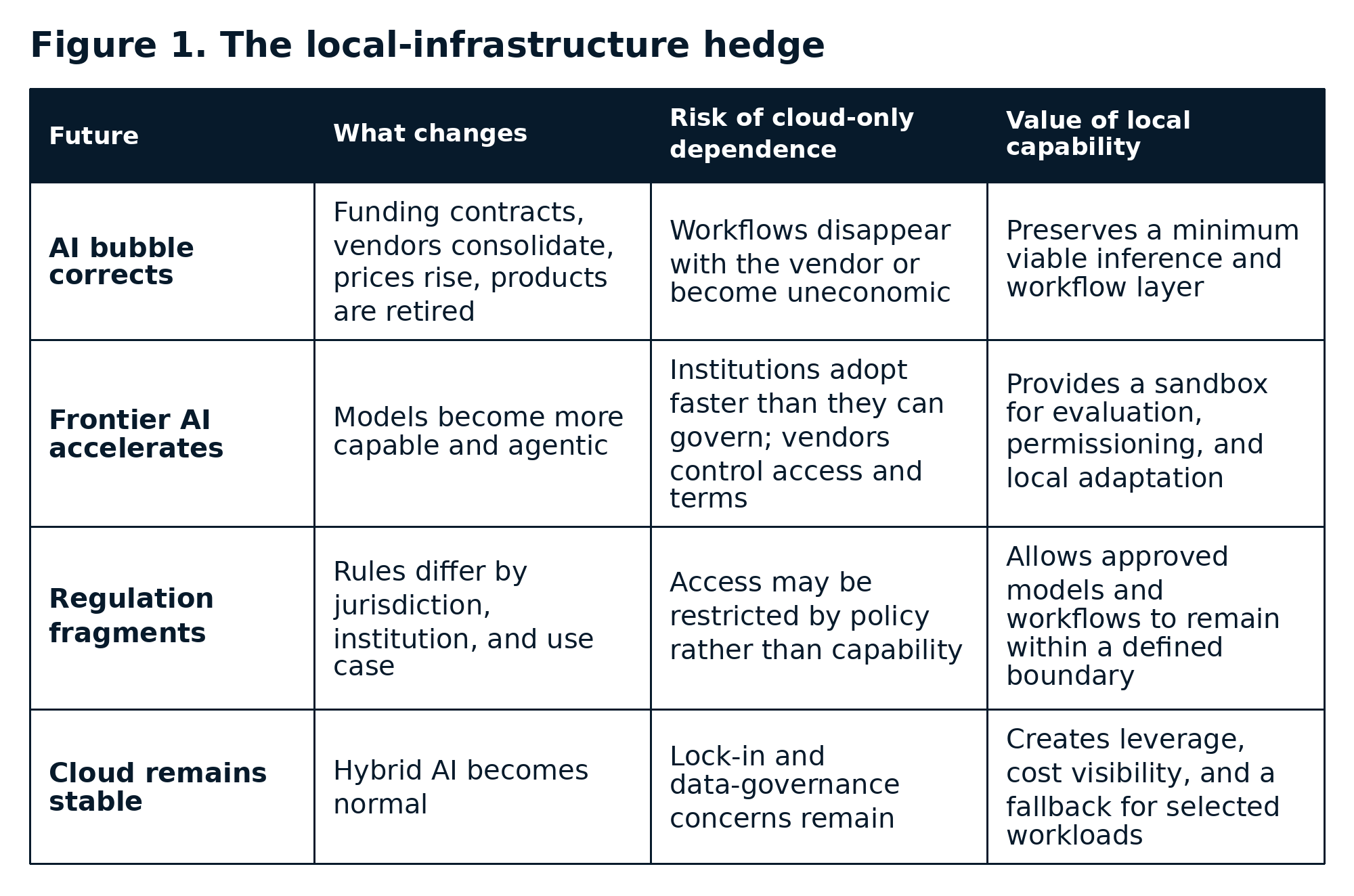
Local infrastructure has value in both.
If the bubble bursts, local models preserve a usable floor. Open weights, local runtimes, downloaded documentation, evaluation sets, and physician-owned workflows do not guarantee independence, but they reduce the chance that one vendor decision can switch everything off.
If capability accelerates, local infrastructure gives clinicians and institutions a controlled place to test, measure, adapt, and govern that capability before handing it authority. It creates bargaining power.
If neither extreme occurs and the current mixed environment persists, local systems still provide value for bounded, high-volume, privacy-sensitive, or latency-sensitive work.
This is what a hedge means. It is not a prediction. It is a position that remains useful across multiple plausible futures.
Figure 1. The local-infrastructure hedge
The practical conclusion
I do not know whether AI infrastructure will undergo a correction, achieve sustainable abundance, or settle somewhere between those outcomes. I do know that physicians should not allow access to their workflows, institutional knowledge, and professional leverage to depend entirely on the commercial decisions of a few companies.
The first step is not buying the largest machine available. It is identifying what we need to preserve: our data, evaluations, workflows, decision rights, and a minimum viable ability to run selected tasks without a particular vendor.
This is Practical AI.