



Unfortunately, I often use the electronic medical record as a poorly organized digital paper chart. The information may be somewhere in the system, but finding it and reconstructing what it means still requires much of the same work that it did when records arrived in a thick folder. I search through notes, reports, and scanned documents to understand what has happened, what remains unresolved, and what needs to happen next. The chart is electronic; the work of assembling the patient’s story is still largely mine and probably more laborious than 20 years ago.
That experience feels a long way from the promise that made electronic records so appealing. Information would follow the patient, become easier to retrieve, and help clinicians make better decisions. Electronic records have delivered meaningful capabilities, and I would not suggest that returning to paper is the answer. But having information available is not the same as having it organized into something useful at the moment a decision must be made. Too often, the physician remains responsible for turning a collection of documents into a coherent understanding of the patient.
Artificial intelligence could help with that work. My concern is that we are initially applying it to a task that may compound the problem: producing more documentation. If we use increasingly capable systems to generate increasingly elaborate notes, we could make the chart easier to write and harder to read. We may have an opportunity to redesign how clinical information is organized, interpreted, and presented so that it supports the next decision rather than simply recording the last encounter.
Moving information is not the same as making sense of it
Poor communication between software systems is an obvious part of the problem. Records may arrive as scanned pages, separate attachments, or poorly formatted documents that are technically accessible but disconnected from the rest of the clinical history. A physician can have access to several systems and still spend considerable effort finding the relevant information across them. The existence of a connection does not guarantee that the information arrives in a form that supports clinical work.
Even when every document is available… another task remains. Someone must determine which medication list is current, whether a diagnosis is active or copied forward, and whether a proposed treatment was discussed, ordered, or actually delivered. Dates, sources, and the status of a decision matter. Several notes repeating the same statement do not necessarily represent several independent confirmations of it. All the while, our primary information source (the patient) may or may not even know their medical history or understand their problem/diagnosis. This is the complicated world of medicine we currently live in. No wonder everyone is becoming increasingly frustrated…
This is why interoperability, although essential, cannot solve the entire problem. Connecting records helps move information; it does not automatically reconcile conflicting accounts or establish what they mean for the patient today. A useful clinical system needs to preserve those distinctions rather than flatten the contents of the chart into a single confident narrative.
A longer note is not necessarily a better handoff
Clinical notes have several audiences, and those audiences do not always need the same things. The next treating physician needs to understand the assessment, the reasoning, and the plan. A payer or auditor may be looking for support for a billed service. A later legal review may examine what was known, discussed, or decided at a particular time. The note has become a place where these different purposes compete, sometimes at the expense of straightforward clinical communication.
That does not mean every long note is required for billing, or that including more language necessarily provides greater legal protection. It means we have developed documentation habits that often favor apparent completeness over usefulness. Repeated histories, copied material, and boilerplate can make it difficult to distinguish a meaningful change from information that has simply been carried forward. The reader has to do the editing that the record never did.
AI-generated documentation can reproduce this tendency. A system may produce a fluent account of an encounter while giving too much weight to incidental details, restating familiar information, or adding language that does little to clarify the clinical situation. In my experience, AI-generated notes can sometimes become cluttered enough to make the record harder to understand, even when the prose itself sounds polished.
Unnecessary detail and unsupported statements are different problems, and we should not confuse them. Extra detail consumes attention. A finding, rationale, or recommendation that was not actually established can alter how another clinician understands the patient. An effective documentation tool needs to be evaluated for both: whether it communicates efficiently and whether its statements faithfully represent what is known and what occurred.
When a note sounds more certain than the decision really is
There is another concern that becomes particularly important at the boundary between specialties. I read notes from referring clinicians that recommend a particular course of action when its appropriateness still depends on an evaluation within my specialty. A referral can reasonably include a proposed approach or a question about treatment. The difficulty arises when the wording makes a possibility sound like an established decision.
AI could make that distinction easier to lose. A clinician reviewing an AI-generated note may be well equipped to assess the parts within their own practice, yet lack the specialty-specific context needed to recognize why a treatment recommendation elsewhere in the note is incomplete or premature. The sentence may sound medically sophisticated and fit smoothly into the assessment, even though the patient-specific reasoning required to support it has not taken place.
Consider the difference between referring someone for evaluation of whether a treatment is appropriate versus documenting that the patient should receive that treatment. The first accurately leaves a clinical question open. The second implies that someone has resolved it. If that distinction disappears, the patient may arrive expecting a specific intervention, another physician may believe a decision has already been made, or a later note may repeat the recommendation without revisiting its basis.This is a problem.
Those misunderstandings can also complicate questions of responsibility. A statement in the record may later be read as evidence of what a clinician recommended or decided, even if it began as generated wording that received insufficient scrutiny. The legal consequences depend on the circumstances; the immediate clinical concern is that the record can attribute more certainty and authority to a statement than the underlying evaluation supports.
This is why “a clinician reviewed the note” is not a complete answer to the problem. Review must be appropriate to the content. The system should distinguish the referring clinician’s question, a specialist’s recommendation, a patient’s preference, and a plan that has actually been agreed upon. When the necessary evaluation has not occurred, documenting that uncertainty is more useful than filling the space with a plausible recommendation.
What I would want the record to show me
The answer is not simply a shorter note. A brief summary can omit a critical fact just as easily as a long note can bury it. What I would want is a clinically useful view of the patient’s current situation, with the underlying records available when I need to inspect them. It should help me see what has changed, which findings affect the available options, what was decided and why, and what remains uncertain or pending.
The information that matters depends on the decision. A radiation oncologist planning treatment and a primary care physician evaluating a new symptom may need different views of the same history. A useful system would organize information around those needs without pretending that one universal summary can serve every purpose. It would also show where its account came from, when the information was recorded, and whether a statement represents an observation, a proposal, or an approved plan.
After a clinical visit, the system should help preserve the decisions that actually emerged from the encounter. What needs to happen next? Who is responsible? What information must arrive before the next decision can be made? Which possibilities were discussed but not selected? These are practical questions, but answering them accurately requires more than compressing a transcript. It requires preserving the status of the clinical reasoning rather than turning every discussion into a definitive conclusion.
That would be a substantial redesign of how we organize and use the record, even if much of the underlying software remained. The full documentation could remain available for clinical, administrative, and legal purposes while the working view helped the physician understand the patient and act. Importantly, the concise view would not become a substitute for the source record or a way to hide disagreement. Its value would depend on making uncertainty and relevant evidence easier to inspect.
The same problem is appearing outside medicine
This challenge is not unique to the clinic. In daily life, we have access to more reporting, analysis, and commentary than we can reasonably absorb. AI is also making it easier to produce information, which is increasing the burden on the people expected to read it. The scarce resource is not another explanation of a subject; it is the time and attention needed to determine what has changed, whether it is credible, and why it matters.
A personal agent could help by preparing a detailed but manageable briefing about developments relevant to someone’s responsibilities and circumstances. Rather than delivering an endless stream of headlines, it could explain which changes deserve attention and provide sources for further examination. A daily report might be a useful starting point, supplemented by selective updates when something important changes. More frequent reporting would only be helpful if it reduced uncertainty rather than becoming another stream to keep up with.
There are risks in delegating that filtering. A personalized system should not simply reinforce existing interests or quietly exclude information that challenges them. Nor should it make confident judgments about relevance without allowing the user to inspect the basis. The goal is to help people understand more of the world, not to replace it with a smaller, more comfortable version.
Medicine presents the same challenge with higher consequences when important context is lost.
Keeping up with evidence is different from knowing when to change practice
Physicians face an additional layer of complexity because the information outside the chart continues to change. If AI helps accelerate research, the challenge will not merely be reading more papers. It will be determining which findings are reliable enough, relevant enough, and mature enough to change care. Faster access to a result does not establish that it applies to the patient in front of us.
A useful clinical agent would do more than announce that a new study had appeared. It would explain how the finding relates to existing evidence, which population was studied, what limitations remain, and whether the result changes an established recommendation or raises a question that needs further investigation. It would help the physician distinguish an interesting development from a practice-changing one, while leaving the clinical decision with the responsible clinician.
This connects directly to the problem inside the record. Whether the source is a new paper or a referring physician’s note, polished language should not erase the difference between evidence, interpretation, and recommendation. A system that helps us maintain those distinctions could be extraordinarily useful. One that collapses them into an authoritative-sounding answer could make it harder to recognize when more thought or a different specialist’s judgment is needed.
We need to rethink the system we are building
Much of the current effort to bring AI into healthcare starts with the software we already have and asks how AI can make it easier to use. That can produce worthwhile improvements, but it also accepts a great deal of inefficiency as a permanent feature of the environment. We teach an agent to search through a disorganized chart, extract information from a note, enter it somewhere else, and follow up through another application. The person may do less work, but the underlying system still requires the same unnecessary steps.
I think we should be asking a more fundamental question: if we were designing clinical software today, with the expectation that AI agents would participate in the work, would we organize it this way at all? Would we make a narrative note the principal vehicle for communicating a treatment plan between systems? Would we require someone, human or otherwise, to search through successive documents to determine whether a recommendation became a decision or whether a requested action ever happened? Many of the workflows we are now trying to automate reflect limitations of the software rather than requirements of patient care.
A system designed around agentic workflows would need a different foundation. Clinical observations, interpretations, proposed treatments, approved decisions, and pending tasks would need to be represented distinctly, with their sources and responsible clinicians attached. Applications would need dependable ways to exchange that information and coordinate authorized work without repeatedly translating it into documents for another system to read. The narrative would remain valuable for explaining clinical reasoning, but it would not have to serve as an improvised communication protocol for the entire care process.
Consider faxing a referral. Instead of sending a note and hoping the receiving office can assemble everything it needs, the systems could share the clinical question, the relevant evidence, the missing information, and the steps required before an appointment or treatment decision. An authorized agent could work on those requirements, update their status, and bring unresolved issues to the appropriate person. It would not have to infer that a treatment had been approved because a sentence sounded definitive; the system would distinguish a proposed option from a decision made by the responsible clinician. That distinction would be part of how the software works, not merely an instruction asking the AI to be careful.
The physician’s interface would change as well. Rather than spending so much of the visit navigating applications and reconstructing events, we could work from a view organized around the patient’s current problems within our context and the decisions in front of us. We would need to see the evidence, question the system’s interpretation, correct errors, and approve consequential actions. Good design would make those responsibilities easier to exercise, while allowing routine coordination to proceed within clearly defined limits. Building for agents should give clinicians better control over the work, not make the process less visible.
The patient may bring their own AI
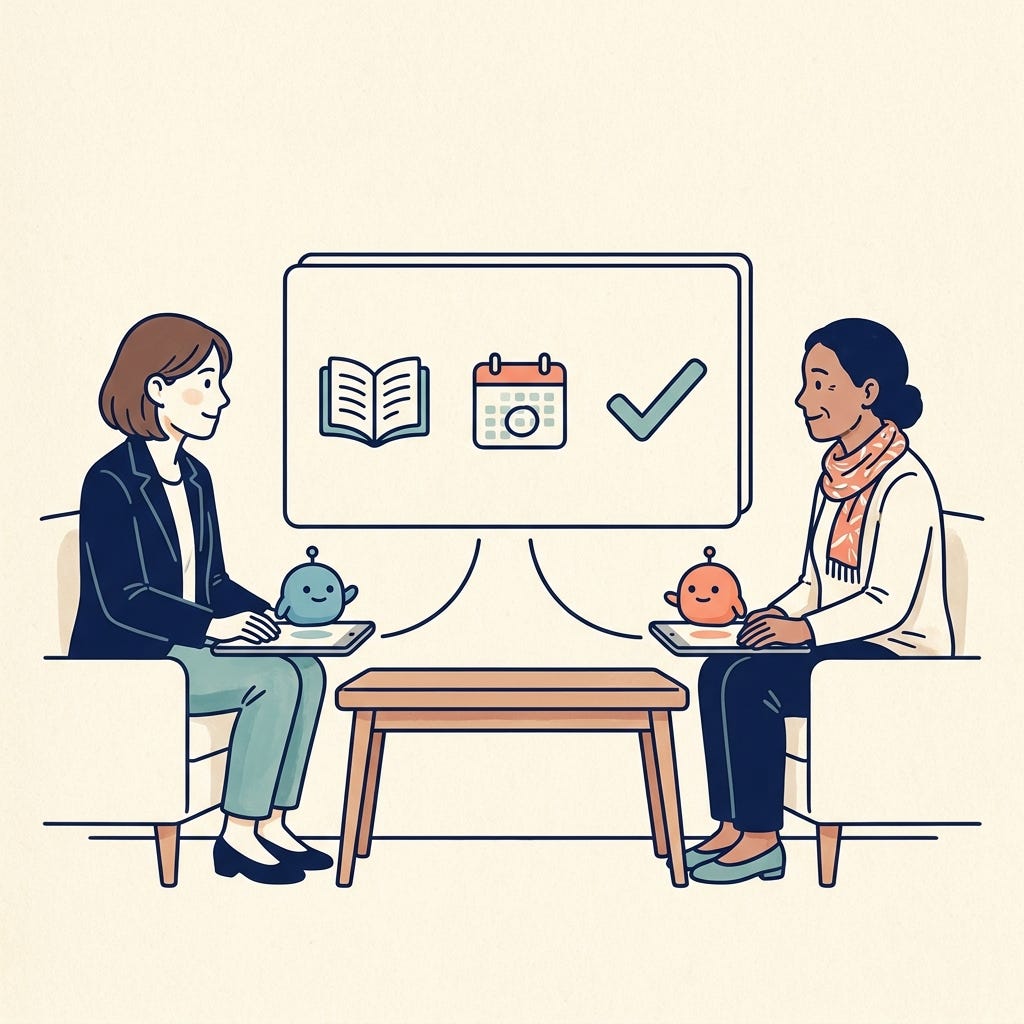
We should also consider what happens as more patients arrive with AI assistants of their own. Some may use them to organize appointments, understand medical information, manage finances, or keep track of responsibilities across their lives. If these assistants become a routine part of how people navigate the world, healthcare systems will need a dependable way to communicate with them. Giving the patient another PDF to upload into a chatbot would carry today’s fragmentation into a new setting.
With the patient’s permission, a personal agent could receive an accurate account of what was decided during a visit, which questions remain open, and what needs to happen next. It could help explain the plan in language the patient understands, prepare questions for the care team, and organize practical details such as appointments and instructions. It could also help the patient communicate information back to the practice, including barriers that may otherwise remain invisible until a follow-up is missed. The agent would support the patient’s understanding and participation, not replace the relationship with the clinician or independently change an agreed treatment plan.
For that exchange to be trustworthy, both sides would need more than access to a collection of notes. They would need to know which version of the plan is current, who approved it, whether it has changed, and which actions have actually been completed. An acknowledgment from an agent could confirm that information was received, but it would not establish that the patient understood it or consented to treatment. Those distinctions would need to remain explicit, especially when a misunderstanding or disagreement requires a direct conversation.
A patient’s permission would also need to be specific. An assistant that helps with household finances should not automatically gain unrestricted access to medical information simply because it serves the same person. Patients would need control over what is shared, what their agent may do on their behalf, and how that access can be withdrawn. They should be able to choose or change assistants without losing access to their care information, and healthcare systems would still need to serve people who prefer not to use one.
This possibility strengthens the case for redesigning the underlying software. We would no longer be building only for clinicians interacting with an electronic record. We would be building for care teams, patients, and authorized agents working across organizational boundaries. If we simply give each participant an AI tool while leaving them to interpret disconnected documents, we may automate the misunderstandings as readily as the useful work. A better foundation would allow them to exchange a clear, current account of the plan while preserving who is responsible for each decision.
What I want from the next medical record
This would be a substantial software overhaul, although it would not require every existing system to be replaced at once. Healthcare would still need to preserve its records and maintain continuity while new capabilities were introduced. But a gradual transition is different from treating today’s architecture as the destination. We should be designing toward systems that can support this way of working, rather than indefinitely adding AI workarounds to software built on different assumptions.
The medical record could become less of a place everyone has to log into and more of a dependable source of information and coordinated work, accessed through interfaces suited to the clinician, the patient, or an authorized agent. The underlying history would remain available, but the daily experience could center on understanding the current situation and carrying out the agreed plan. The clinical note would remain useful without being asked to carry the entire burden of communication between people and systems.
That is ultimately what I want from AI in my clinic. Faster documentation would be welcome, but I do not want the next generation of medical software to be defined by how efficiently it operates the last one. I want us to reconsider why so much searching, copying, reconciling, and chasing is necessary in the first place. If we are willing to redesign the system around clinical understanding and coordinated action, rather than add intelligence to each inefficient step, we have a chance to deliver something much closer to what the electronic medical record originally promised.