


A tool is useful only if it still leaves you as the person who owns the result. That is the rule.
You are here for a preflight check you can run before a tool touches a patient or a chart. Most writing about these tools comes from people who do not sign the note.
What this is
This is not clinical decision support. It is not a vendor roundup. It is not an argument that AI will replace you. It is four questions.
Do not let a tool near a patient or a chart until you can answer them.
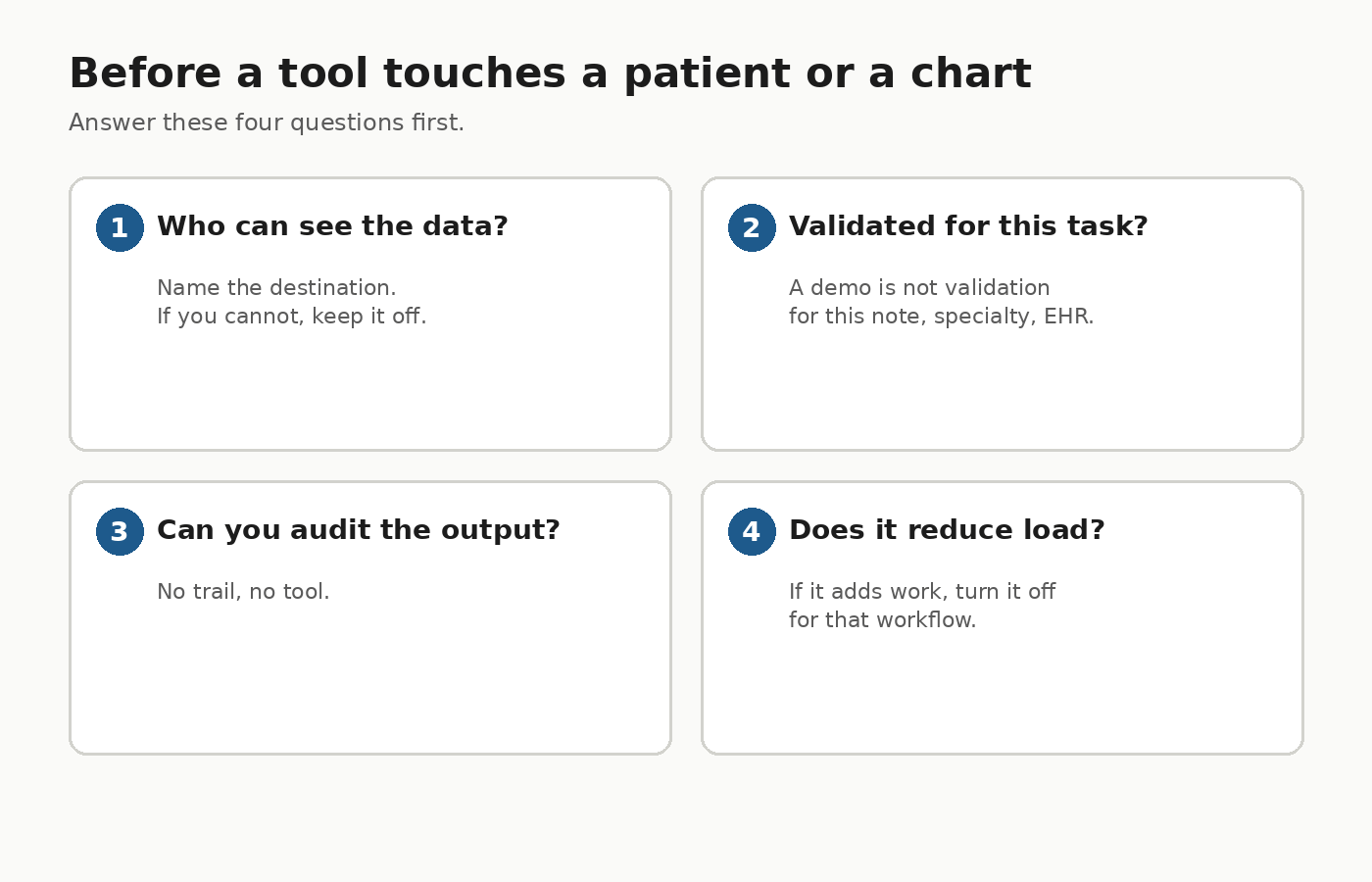
1. Who can see the data, and where does it go?
If audio, a note, or a chart leaves the office, name who receives it and where it sits. A public consumer chatbot is a third party you did not contract, on servers you do not control, with a retention story you often cannot verify.
Prefer the lowest-exposure option that still fits the job: a local or self-hosted model when the workflow and hardware support it, or a governed vendor product when the contract, tier, connectors, and retention have been checked for this use. When a vendor must handle ePHI, a BAA is necessary for that arrangement. A BAA is a contract, not a privacy sticker. It does not by itself validate the clinical workflow. If you cannot name the destination, keep the tool off that data.
2. Has it been validated for the specific clinical task?
A demo is not validation. “Works for documentation” is not the same as evidence for this note type, in this specialty, in this EHR, against this template.
If a vendor claims ambient capture of a follow-up visit, ask for evidence on that task, not a staged new-patient video from another specialty or an integration you do not have. Until you have that, treat the output as untested draft language.
3. Can its outputs be audited and traced?
If you cannot show where a sentence came from, do not file it. The model drafts. Point to the transcript, the report, the policy line, or the lab. A clean paragraph with no trail is a guess you will have to defend later.
No trail, no tool.
4. Does it reduce cognitive load rather than add to it?
A draft that forces three extra screens, or a message you still rewrite and then re-file into a second inbox, has not helped. The test is whether the person who already owns the step is lighter after the draft. If the tool adds load, turn it off for that workflow.
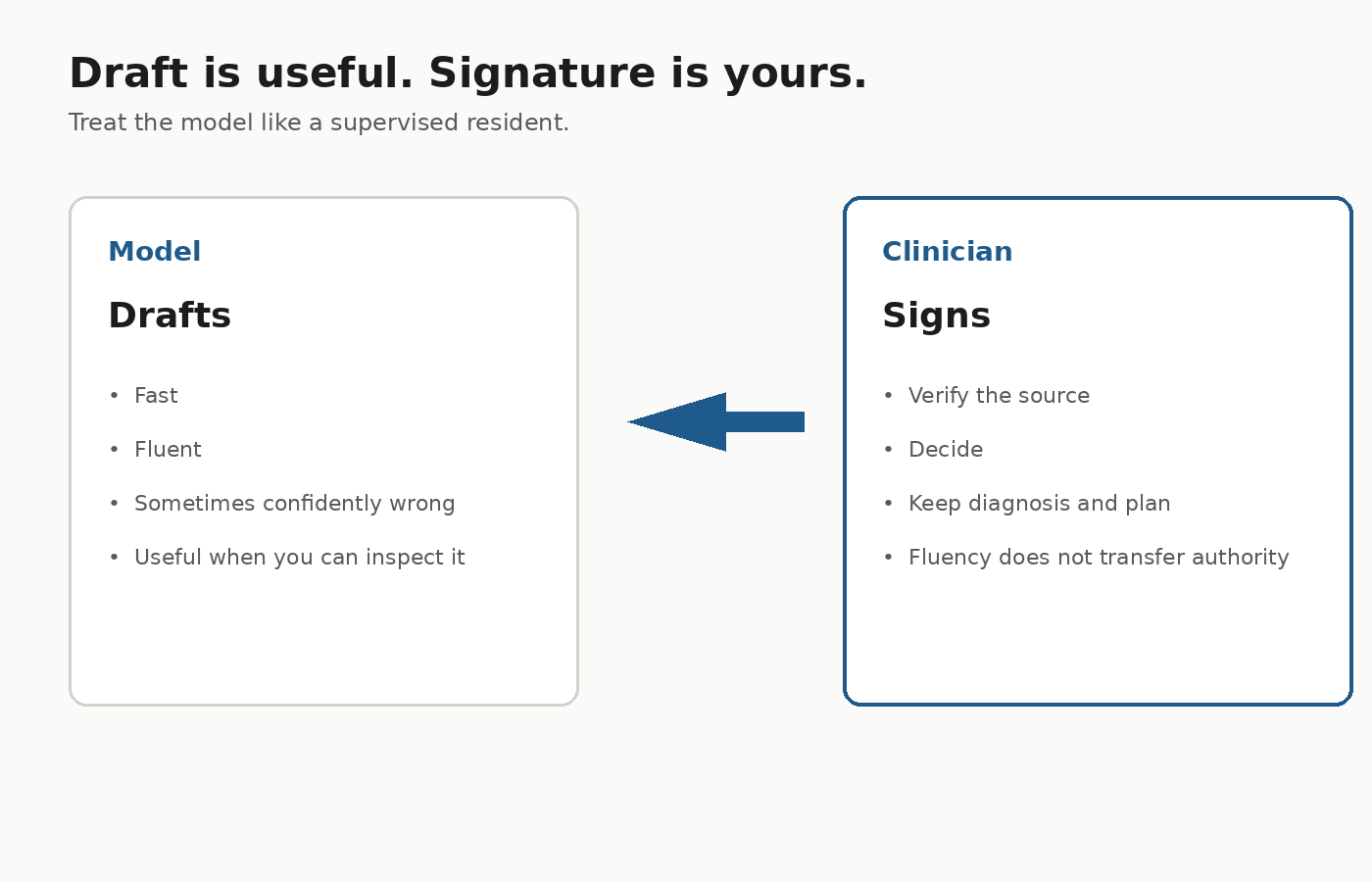
Practical rule
Treat these systems like a supervised resident: fast, fluent, sometimes confidently wrong. Let it draft. You verify the source. You decide. Diagnosis, treatment decisions, final consent, dose, and plan sign-off stay with the clinician.
Fluency does not transfer authority.
You are the provider.